
Wedding Season Gold Buying Guide 2026: How to Get the Best Rate
17 Nov 2026 · GoldRateToday
Wedding gold is bought once and worn for years. Get the purity, the weight and the bill right, and the rate takes care of itself.
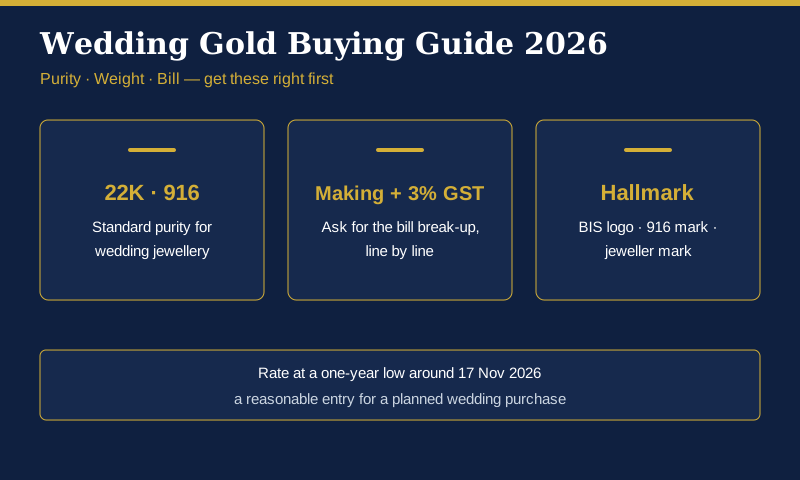
The short answer
The rate has also fallen to a one-year low around 17 November 2026, which is a reasonable entry for a purchase you were going to make anyway. But do not try to catch the exact bottom. A wedding purchase is decided by the design and the budget, not by a single day's rate.
Fix purity and weight first
Start by fixing the purity. For jewellery, that is almost always 22K, marked 916, because it is strong enough to hold its shape and it is the purity Indian jewellers and buyers know best. For coins and bars, choose 24K, because you are buying gold itself rather than a design, and 24K is the easiest to value anywhere.
Then fix the weight. Rates are quoted per gram and per 10 gram, and in Kerala also per pavan, which is 8 grams. A quote that looks cheap per gram may be expensive per 10 gram if the purity is different, so convert everything to the same unit before you compare. Write down the purity and weight for each piece before you go to the shop, so a busy counter cannot change them.
- 22K (916) for jewellery — strong enough to hold its shape; 24K for coins and bars.
- Rates are quoted per gram and per 10 gram; in Kerala, per pavan (8 grams).
- Convert every quote to the same unit before you compare.
Benchmark first, then the jeweller's quote
Check a benchmark first, such as the rate on this site for your city and purity, so you have a reference point for the day. Then ask your jeweller for a quote for the same purity and weight. The jeweller's quote should be higher, because it adds import duty, a dealer premium, GST and a making charge. The question is not whether it is higher, but by how much, and whether each addition is shown separately.
If a shop gives you only a single total, ask for the break-up. A clear bill shows metal cost, making charge and GST as separate lines. A shop that will not show the break-up is a shop to walk away from, however good the headline rate sounds. Compare two or three jewellers on the same purity and weight, and compare their totals, not their headline rates.
Making charges and GST
Making charges vary by design. A simple chain or bangle takes less work than a detailed temple necklace or a stone-set ring, so it should cost less to make. Making charges are quoted as a percentage of metal cost or as a fixed amount per gram. Either format is fine, but you should be able to convert one to the other, and you should ask whether the charge applies to the metal weight only or to the total weight including stones. Stones are not gold, so a charge applied to stone weight inflates the bill.
GST on gold jewellery is 3% on the value of the gold plus the making charge, and your bill should show it as its own line. Keep the bill. It proves the purity, weight, rate, making charge and GST you paid, and it is what you will need if you exchange or sell the piece. If a shop offers a lower price for a bill without GST, walk away: you lose the proof of purchase and any easy resale.
Hallmark checks
A hallmarked piece in India carries three marks: the BIS logo, the purity mark such as 916, and the jeweller's identification mark. Newer pieces also carry a six-digit alphanumeric code, which can be checked to confirm the piece. Together they say who sold it, what purity it claims, and that it was tested by a recognised centre.
Check the marks before you pay, and make sure the bill states the same purity, the weight in grams and the rate per gram. If the bill says something different from the mark, ask why before you pay. For a full wedding set, confirm the purity of every piece, not just the first one: a set can mix 22K pieces with lower-purity clasps or fittings, and the bill should show the gold parts separately from any stones.
- BIS logo, purity mark such as 916, and the jeweller's identification mark.
- Six-digit alphanumeric code on newer pieces — check it to confirm the piece.
- The bill must state the same purity, weight in grams and rate per gram as the mark.
Comparing jewellers, and when to buy
To compare two shops fairly, ask each for the same thing: the metal cost for your weight and purity, the making charge and the GST, as three separate lines. Add them up yourself. The shop with the lower total is cheaper, even if its headline rate looked higher. Also ask whether the making charge is refundable on exchange, because some shops deduct it in full when you exchange a piece and others return part of it.
On timing, the rate around 17 November 2026 is at a one-year low, which suits a planned wedding purchase. But gold moves every day, and a morning rate is not a promise for the evening, so check the rate on the morning you plan to buy and again when you reach the shop. Buy the pieces you have planned, from a shop you trust, and let the rate be a good entry rather than a gamble on the lowest point of the month.
Related Pages
Today's gold rate in India · Today's 22K rate · Gold price calculator · Gold rate in Chennai · Gold rate in Bangalore · All blog posts
Sources: Bureau of Indian Standards — hallmarking
Benchmark rates only, before GST and making charges. Not investment advice.